
If you’ve ever stood in your garden looking up at a large tree and wondered how it could safely be removed, you’re not alone. Tree removal often looks simple from the outside, but in reality, it involves careful planning, technical skill, and the right choice of method. In a coastal town like Blackpool, where strong winds, soft ground, and tightly packed residential areas are common, selecting the correct tree removal techniques is essential. At LH Tree Services, we regularly assess trees in complex environments where the wrong approach could lead to serious damage.
Why Choosing the Right Tree Removal Technique Matters
Tree removal is not a one-size-fits-all process. Every tree presents a different challenge depending on its height, condition, and location. A large tree growing in an open field can often be removed in a single cut. However, in a residential garden surrounded by fences, conservatories, or neighbouring homes, a far more controlled method is required.
Using the correct technique helps to:
- Protect nearby structures and property
- Reduce risk to people and pets
- Ensure safe handling of heavy timber
- Maintain efficiency and minimise disruption
Choosing the wrong method can lead to uncontrolled falls, property damage, and increased costs.
Straight Tree Felling
Straight felling is one of the most traditional tree removal techniques. It involves cutting the tree at its base so that it falls in a predetermined direction. This method works best when there is sufficient open space and no obstacles nearby. Tree surgeons carefully plan the fall direction, taking into account wind conditions, tree lean, and weight distribution. While it may look straightforward, even straight felling requires experience. A miscalculated cut can cause the tree to fall unpredictably. In Blackpool, where space is often limited, this technique is less commonly used in residential areas but remains effective in open environments.
Sectional Tree Dismantling
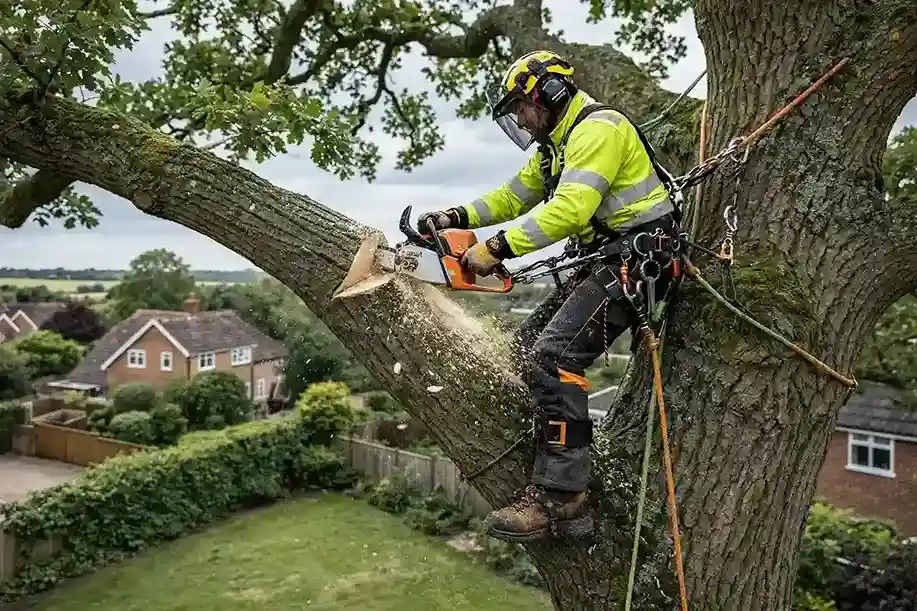
In most residential settings, sectional dismantling is the preferred approach. Instead of cutting the tree in one piece, it is removed in smaller sections from the top down. A trained tree surgeon climbs the tree using specialised equipment and carefully removes branches and trunk sections one at a time. Each piece is either lowered using ropes or dropped in a controlled manner, depending on the available space.
This technique is ideal when:
- Trees are close to buildings or fences
- There is limited access or working space
- Precision is required to avoid damage
Sectional dismantling is more time-consuming than straight felling, but it provides a much higher level of control and safety.
Rigging and Controlled Lowering
When removing large or heavy sections of a tree, rigging systems are often used. This technique involves ropes, pulleys, and friction devices to carefully lower branches to the ground. Rather than allowing heavy limbs to fall freely, tree surgeons guide them down slowly, reducing impact and preventing damage.
Rigging is especially important in areas where:
- Trees overhang roofs or driveways
- Heavy branches could damage structures
- Ground space is restricted
This method requires advanced skill and coordination, but it is one of the safest ways to manage large trees in urban environments.
Crane-Assisted Tree Removal
In certain situations, crane-assisted removal may be necessary. This is typically used for very large trees or when access is extremely limited. A crane lifts sections of the tree while they are cut, allowing them to be removed without dropping or lowering them manually. This technique is often used when a tree is:
- Too large for safe manual dismantling
- Positioned over buildings or obstacles
- Structurally unstable
While crane removal can be more expensive, it significantly reduces risk in complex scenarios.
Stump Grinding and Removal
Once a tree has been removed, the stump remains. Leaving a stump in place can lead to regrowth, attract pests, and create an obstacle in your garden. Stump grinding is a common follow-up technique. A specialised machine grinds the stump down below ground level, allowing the area to be reused or landscaped. In some cases, full stump removal may be required, particularly if construction or planting is planned.
Emergency Tree Removal Techniques
Storms are a common cause of tree damage in Blackpool. High winds can uproot trees, snap branches, or weaken structures. Emergency tree removal requires a slightly different approach. The focus is on immediate safety rather than routine dismantling.
Tree surgeons assess:
- Structural stability
- Tension within the branches and trunk
- Risk to nearby property
Damaged trees are often removed in controlled sections to prevent sudden collapse. Emergency situations demand experience, as trees under stress behave unpredictably.
Environmental and Safety Considerations
Professional tree removal techniques are designed not only for efficiency but also for safety and environmental responsibility.
Tree surgeons follow strict safety procedures, including:
- Risk assessments before work begins
- Use of protective equipment
- Establishing safe working zones
In addition, responsible disposal of wood and debris ensures minimal environmental impact. In some cases, timber can be recycled or reused rather than discarded.
Real Example From Blackpool
We were recently called to a property in Blackpool where a large tree was growing close to a conservatory. The homeowner initially believed it could be cut down in one piece. However, due to the limited space and risk of damage, sectional dismantling with rigging was used instead. Each section was carefully lowered, and the tree was removed without any impact on the surrounding structure.
How to Choose the Right Tree Removal Technique
The best method depends on several factors, including:
- Tree size and condition
- Location and surrounding obstacles
- Ground stability
- Access to equipment
A professional assessment ensures that the safest and most efficient approach is selected.
Final Thoughts
Tree removal is far more complex than it appears. Different situations require different tree removal techniques, and choosing the wrong one can create unnecessary risks. Whether it’s straight felling in an open space or controlled dismantling in a residential garden, each method has its place. In areas like Blackpool, where environmental conditions and property layouts vary, professional expertise is essential. If you’re considering tree removal, contacting a qualified team such as LH Tree Services ensures the job is carried out safely, efficiently, and with the right technique for your specific situation.
Frequently Asked Questions (FAQs)
What is the safest tree removal technique in residential areas?
The safest method is usually sectional tree dismantling, where the tree is removed piece by piece. This allows tree surgeons to control each cut and avoid damage to nearby homes, fences, or vehicles.
Can a tree always be felled in one piece?
No. Straight tree felling is only suitable when there is enough open space. In most residential areas in Blackpool, controlled methods like dismantling or rigging are required.
What is rigging in tree removal?
Rigging involves using ropes and pulleys to safely lower heavy branches or sections of a tree to the ground. It prevents damage and ensures controlled removal in tight spaces.
When is crane-assisted tree removal needed?
Crane-assisted removal is used for very large or dangerous trees, especially when access is limited or the tree is positioned near buildings. It allows sections to be lifted safely without dropping them.
Do tree removal techniques change after a storm?
Yes. Storm-damaged trees are often unstable and require careful assessment. Tree surgeons use controlled dismantling and safety protocols to remove them without causing further damage.
Comments are closed